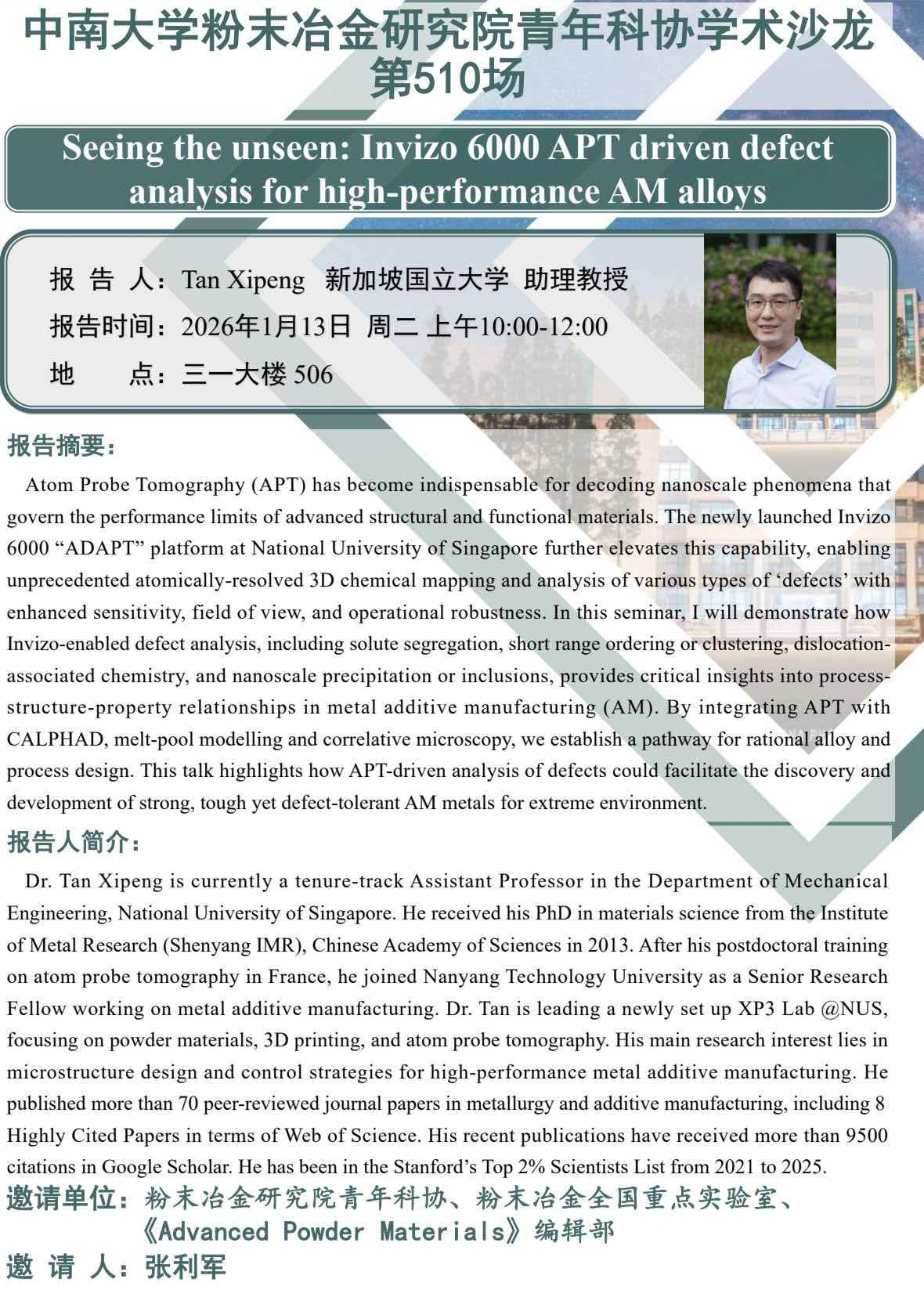
主讲人:TanXipeng 新加坡国立大学 助理教授
时间:2026年1月13日 10:00-12:00
地点:三一大楼506
报告摘要:
Atom Probe Tomography (APT) has become indispensable for decoding nanoscale phenomena thatgovern the performance limits of advanced structural and functional materials. The newly launched Invizo6000 “ADAPT" platform at National University of Singapore further elevates this capability, enablingunprecedented atomically-resolved 3D chemical mapping and analysis of various types of defects* withenhanced sensitivity, field of view, and operational robustness. In this seminar, I will demonstrate howInvizo-enabled defect analysis, including solute segregation, short range ordering or clustering, dislocationassociated chemistry, and nanoscale precipitation or inclusions, provides critical insights into processstructure-property relationships in metal additive manufacturing (AM). By integrating APT withCALPHAD, melt-pool modelling and correlative microscopy, we establish a pathway for rational alloy ancprocess design. This talk highlights how APT-driven analysis of defects could facilitate the discovery ancdevelopment of strong, tough yet defect-tolerant AM metals for extreme environment.
主讲人简介:
Dr, Tan Xipeng is currently a tenure-track Assistant Professor in the Department of MechanicalEngineering, National University of Singapore. He received his PhD in materials science from the Instituteof Metal Research (Shenyang lMR), Chinese Academy of Sciences in 2013. After his postdoctoral trainingon atom probe tomography in France, he joined Nanyang Technology University as a Senior ResearchFellow working on metal additive manufacturing. Dr. Tan is leading a newly set up XP3 Lab @NUSfocusing on powder materials, 3D printing, and atom probe tomography. His main research interest lies irmicrostructure design and control strategies for high-performance metal additive manufacturing. Hepublished more than 70 peer-reviewed journal papers in metallurgy and additive manufacturing, including 8Highly Cited Papers in terms of Web of Science, His recent publications have received more than 9500citations in Google Scholar, He has been in the Stanford's Top 2% Scientists List from 2021 to 2025.